
Why developers need to understand demand before they try to activate sales.
For years, residential development has worked around a familiar sequence: secure the site, navigate planning, define the scheme, build the product, appoint the agent, produce the CGIs, launch the listing, then wait for buyers to respond.
That sequence still works when demand is easy, confidence is high and buyers are willing to compromise. But that is not the market developers are operating in now.
Today’s buyer is more stretched, more selective and more commercially aware. They are not just choosing between one home and another. They are weighing a home against mortgage pressure, rental pressure, energy bills, family support, lifestyle compromise, future flexibility and whether property still feels like the smartest place to put their money.
This creates a new challenge for the housing industry: many developments are still being brought to market as if the buyer is obvious.
They are not.
The next advantage in residential development will not come from better brochures alone. It will come from better demand definition before the scheme is asked to sell.
The buyer has not disappeared. But the buyer has changed.
The story is not that people no longer want to buy homes. They do.
The English Housing Survey found that 69% of people aged 16 to 34 still expect to buy a home at some point. The aspiration remains remarkably resilient. But the journey has become longer, harder and more conditional: among those expecting to buy, 49% believe it will take five years or longer, while 34% expect it to take two to five years.
That matters because aspiration is not the same as action.
A buyer can want ownership and still hesitate. They can afford the deposit and still question the monthly commitment. They can like the home and still delay the decision if the proposition does not feel clear, future-proofed or worth the stretch.
For developers, this changes the commercial task. The role is no longer simply to present available homes. It is to help the buyer believe that this specific development is the right move at the right time.

Affordability has improved statistically, but not emotionally.
On paper, affordability has improved. ONS data shows that in 2025, the median home in England cost £300,000, equivalent to 7.6 times median full-time annual earnings. In Wales, the median home cost £213,000, equivalent to 6.0 times earnings. Since 2021, median house prices rose by 5%, while average earnings rose by 25%.
That sounds positive. But for most buyers, affordability is not experienced as a ratio. It is experienced as a monthly payment, a deposit gap, a stress test, a family conversation, a commute trade-off and a fear of overpaying.
The English Housing Survey also reported that the average first-time buyer deposit in 2024–25 was £78,131, with a median of £36,500. Most first-time buyers were concentrated in the top two income quintiles, showing how access to ownership remains weighted towards higher-income households.
This is where many development propositions fall short. They show the product, but not always the value case. They describe the number of bedrooms, but not the life the home supports. They show the kitchen finish, but not why the buyer should feel confident committing now.
In a stretched market, beauty is not enough. Buyers need reasons.
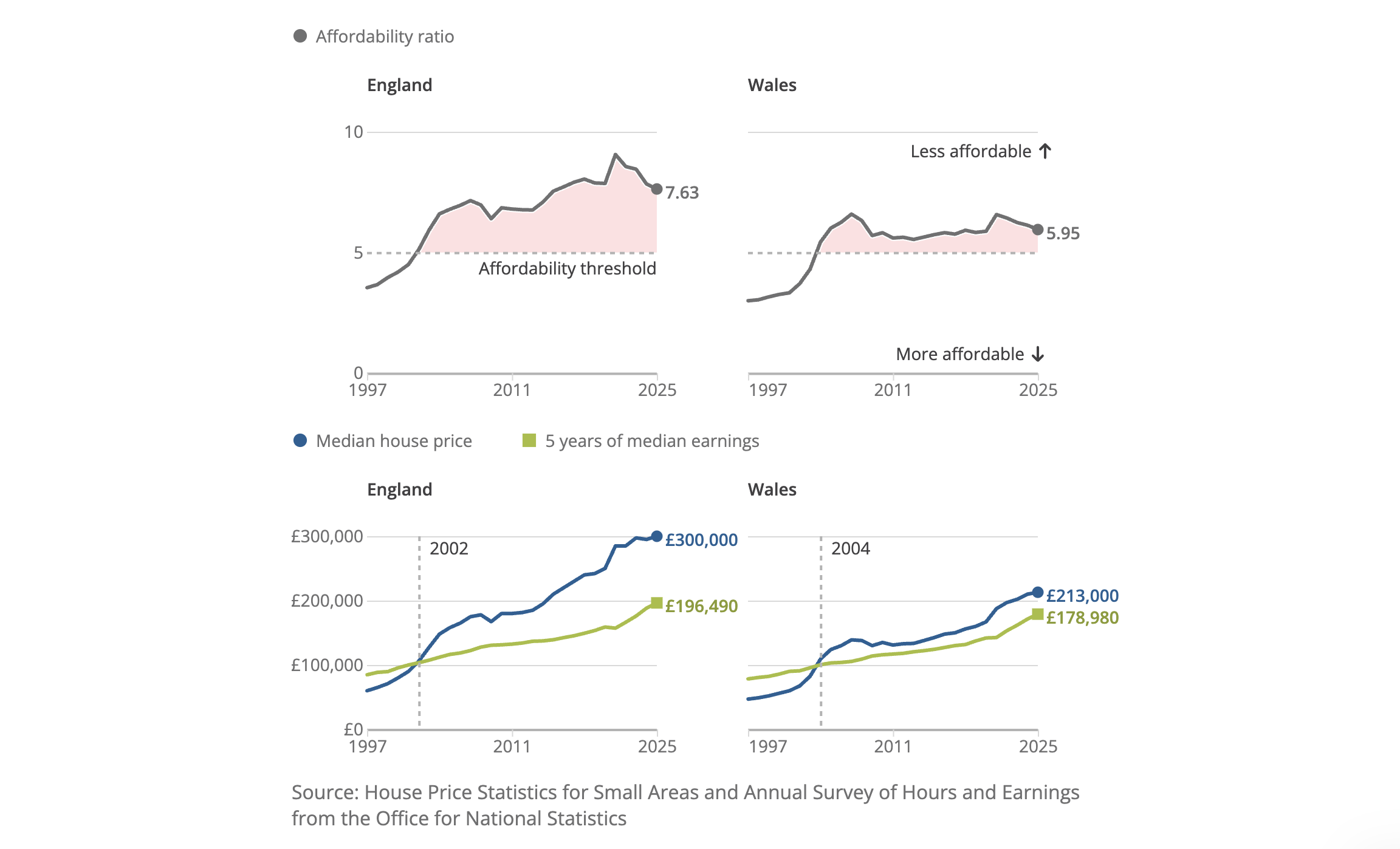
ONS: Housing affordability ratio, house prices, and five years of earnings by country, England and Wales, 1997 to 2025
The real risk is not weak demand. It is assumed demand.
A common mistake in development is to treat “demand” as a broad market condition.
There is demand for homes. There is demand in the South West. There is demand from families. There is demand from downsizers. There is demand from first-time buyers. But broad demand does not sell a specific plot.
Specific demand does.
The developer risk sits in the gap between a market assumption and a buyer reality. A scheme may be well-built, well-located and visually attractive, but still underperform if the product mix, price logic, specification, lifestyle story or sales journey does not align with the people most likely to buy it.
That is a product-market fit problem.
In technology and product innovation, product-market fit is treated as fundamental. You do not simply build a product and hope the customer understands it. You test the audience, define the need, sharpen the proposition, understand the competitive set, map objections and refine the offer until the product and market meet.
Residential development should be no different.
Yet too often, buyer understanding enters the process late, once the biggest commercial decisions are already fixed.
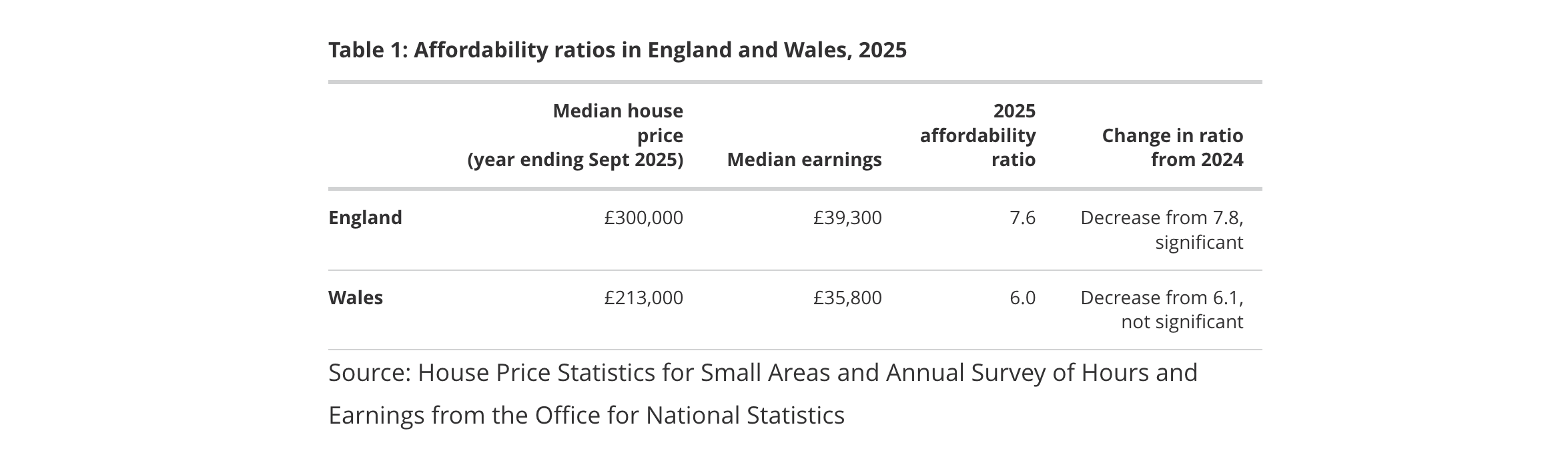
ONS: Affordability ratios in England and Wales, 2025
Marketing cannot rescue every product decision.
There is a point in every development where the product becomes hard to change.
The site is secured. The planning direction is set. The layouts are drawn. The finishes are specified. The price expectations are formed. The CGI brief is written. The agent is appointed.
At that point, marketing can amplify the proposition, but it cannot fully rebuild it.
A CGI can make a kitchen look beautiful, but it cannot fix a layout that does not reflect how the target buyer lives. A brochure can describe local amenities, but it cannot compensate for an unclear location strategy. Listing copy can say “family home,” but it cannot prove why this home is better suited to a young family than the other options nearby.
This is why buyer strategy has to move upstream.
Not because developers need more research for the sake of it. But because the cost of getting the buyer wrong is increasingly commercial: slower sales, heavier negotiation, weaker urgency, price reductions, underperforming plots and missed learning across the wider pipeline.
Buyers are making more complex decisions
The new-build buyer is not only judging aesthetics. They are evaluating risk.
They are thinking about mortgage exposure, running costs, future resale, flexibility, location resilience and whether the home will still work in five or ten years. That is especially important as borrowing remains sensitive. Reuters reported in June 2026 that UK house prices were expected to rise by only 1.8% in 2026, down from a previous forecast of 2.5%, with higher borrowing costs continuing to affect affordability.
At the same time, buyers have more choice. Zoopla reported that buyer demand was running 10% below last year, even as sales agreed were slightly up, suggesting a market where committed movers remain active but selective. Zoopla also reported that first-time buyers were looking at homes priced around £254,750, up 4.3% year-on-year, almost three times the headline rate of UK house price growth.
This creates a sharper challenge for developers. Buyers are still moving, but they need more convincing. They are not only asking “do I like it?” They are asking:
Will this home work hard enough for the money?
Will it reduce or increase my monthly pressure?
Will it give me flexibility if my life changes?
Is this a better decision than waiting?
Will this place hold its appeal?
Can I see myself living here, not just owning it?
Those are product strategy questions before they are marketing questions.
The first-time buyer is not always who developers imagine.
The traditional image of the first-time buyer is often too narrow: young, early-career, looking for a flat, buying the first rung of the ladder.
But the reality is more layered.
Connells reported that first-time buyers purchased 34.3% of all homes sold across Great Britain in January 2026, up from 33.3% the previous year and more than double the 16.8% recorded a decade earlier.
This does not mean every scheme should chase first-time buyers. It means the first-time buyer segment is commercially important, but also increasingly diverse. Some are older. Some are buying with family support. Some are skipping flats. Some are buying with children already in the household. Some are choosing a house not as a starter home, but as a longer-term life platform.
For developers, that matters because the same label can hide very different needs.
A first-time buyer couple in their early thirties with family support and plans for children may have more in common with a second-step family buyer than with a graduate buying a city flat. A downsizer may care less about square footage and more about maintenance, comfort, community and single-level living. A relocating family may care more about schools, broadband, storage, parking and access to landscape than about a premium finish alone.
The segment name is not enough. The use case matters.

Energy performance is now part of the buyer value equation.
New-build homes have a strong story to tell, but the industry does not always translate it well enough.
Energy efficiency is no longer only an environmental benefit. It is a financial reassurance, a comfort signal and a future-proofing argument. With buyers under pressure from mortgage costs and household bills, the running cost of a home is part of the purchasing decision.
The Home Builders Federation and Octopus Energy reported in 2026 that new-build homes save around £420 per year on average compared with older homes, making them 21% cheaper to run. The same report said new builds can be around 39% cheaper to run than older F or G-rated homes.
This is a major advantage for developers, but only if it is made meaningful.
An EPC rating is information.
A warmer, cheaper, lower-maintenance future is a proposition.
The opportunity is to move from technical claims to buyer confidence: lower bills, less upgrade burden, better comfort, stronger future resale, and a home that feels ready for the next decade rather than simply compliant with today.
The market is fragmenting by place, product and lifestyle.
The national market is no longer a useful enough lens on its own. Different regions, property types and buyer groups are moving at different speeds.
Zoopla’s 2026 house price data showed headline UK house price growth of 1.5%, but flats and maisonettes were down 1.3% year-on-year, while semi-detached houses rose 2.5%.
That split matters. It points to a market shaped by space, flexibility, family readiness, tenure confidence and perceived long-term usefulness.
For developers, the implication is clear: product strategy has to be local, specific and evidence-led. A development in Somerset cannot be positioned using the same assumptions as a city apartment scheme. A small rural infill site cannot rely on the same buyer triggers as a large suburban estate. A premium countryside home needs a different proposition from an affordable edge-of-town starter home.
The question is not “what are buyers looking for?”
The better question is “which buyers are most likely to value this specific development, in this specific place, at this specific price point — and what must they believe before they act?”
That is the question too many schemes answer too late.

What developers can learn from product strategy.
In product and innovation strategy, the customer is not treated as the final audience for a launch. The customer shapes the product from the beginning.
Teams build hypotheses. They identify user groups. They map unmet needs. They test value propositions. They compare alternatives. They understand what creates adoption, what causes hesitation and what features create willingness to pay.
Residential development has the same opportunity.
A stronger development process would ask:
Who are the highest-value buyer groups for this site?
What life stage are they entering?
What compromises are they trying to escape?
What are they comparing this home against?
What premium features will they genuinely value?
What will they ignore?
What objections will slow them down?
What visuals will help them believe?
What should the agent be able to say in the first two minutes?
What should this scheme teach us about the next site?
This is not about making development more complicated. It is about making it more commercially intelligent.

From selling homes to designing for demand.
The strongest developers will increasingly be the ones who treat each scheme as both a sales opportunity and a learning system.
A sales sprint should not end when the plot is sold. It should reveal which buyer groups responded, which messages converted, which objections appeared, which images worked hardest, which features mattered and which assumptions were wrong.
That intelligence should then inform the next site, the next product mix, the next planning conversation, the next CGI brief and the next sales strategy.
This is where the development industry has an opportunity to modernise.
Not by copying technology language for the sake of it. But by borrowing the discipline of product-market fit: understanding demand before investing too heavily in supply.
The Lexwell-Partners perspective.
At Lexwell-Partners, we believe residential development needs stronger commercial foundations before sales activation begins.
The opportunity is not just to make developments look better. It is to make them easier to understand, easier to believe in and easier to buy.
That means combining buyer insight, product strategy, proposition development, visual narrative direction and launch activation into one connected system.
For developers, this can support:
sharper buyer definition
stronger product and specification decisions
clearer lifestyle propositions
more focused CGI and visual briefs
better agent alignment
stronger launch materials
faster buyer understanding
smarter learning across future sites
Because in this market, selling the home is only the final act.
The real advantage starts much earlier: knowing who the buyer is, what they value, what they fear, what they are comparing against, and what will make them confident enough to move.
Residential development does not have a demand problem.
It has a clarity problem.
And the developers who solve that first will be the ones best placed to build homes that do more than reach the market.
They will build homes that meet it.
Ready to activate what you’re building next?
Whether you need to create immediate sales momentum, understand your future buyer more clearly, or shape a stronger long-term development pipeline, Lexwell-Partners helps turn property opportunities into commercially sharper activation systems.
From focused sprint activations that help buyers see the finished life sooner, to consumer strategy that uncovers who your audience really is, to pipeline growth strategy that brings clarity across future sites, we help developers move from project-by-project marketing to more confident, market-led growth.
Have a development, portfolio or opportunity you need to bring to life?
Let’s shape it, visualise it and activate it.
Get in touch with Lexwell-Partners to explore how we can support your next activation.