
What South West Home Buyers Want in 2026
Today’s South West home buyer is not simply looking for more space. They are looking for confidence. Confidence that the home is affordable to run, easy to live in, future-proofed against regulation, connected to the right kind of place, and emotionally clear enough to imagine life there before they commit. For developers, this creates a sharper challenge: knowing the audience before planning, designing and selling is no longer a nice-to-have. It is becoming the difference between demand and hesitation.

ONS: Annual change in house prices in Bath and North East Somerset
The South West buyer is still active, but far more selective
The South West remains desirable, but 2026 is not a “build it and they will come” market.
According to the Office for National Statistics, across the South West, the average house price was £301,000 in March 2026, broadly in line with £303,000 a year earlier. For mortgage buyers, the regional average was £300,000, again broadly flat year-on-year. In Bath and North East Somerset, one of the region’s higher-value markets, the average house price was £406,000, down 1.2% from March 2025.
Rightmove’s April 2026 data showed the average asking price in the South West at £387,771, with homes taking an average of 75 days to find a buyer. It also reported that buyer demand nationally was 7% lower than the same period in 2025
This points to a market where buyers are not absent, but they are less forgiving. They are comparing harder, moving slower and expecting stronger reasons to choose one property over another. The opportunity for developers is clear. Homes need to be positioned around specific buyer motivations, not just listed by square footage, specification and location.
Even where affordability has technically improved, buyers still feel stretched.
ONS data shows that in 2025 the median home in England cost 7.6 times median full-time earnings, down from previous peaks. Since 2021, median house prices in England and Wales rose by 5%, while earnings rose by 25%, helping affordability ratios improve.
But improved does not mean easy. For many South West buyers, especially first-time buyers and young families, the total cost of ownership is now the real decision-maker. Mortgage cost, energy bills, council tax, insurance, maintenance, commuting and childcare all sit in the same mental calculation.
This changes what buyers look for. They are not only asking, “Can I afford to buy it?” They are asking:
Can I afford to live in it comfortably?
Will it cost more later?
Does it reduce future risk?
Is the premium justified?
This is why energy performance, low-maintenance materials, flexible spaces and clear running-cost benefits are becoming commercial features, not just technical ones.
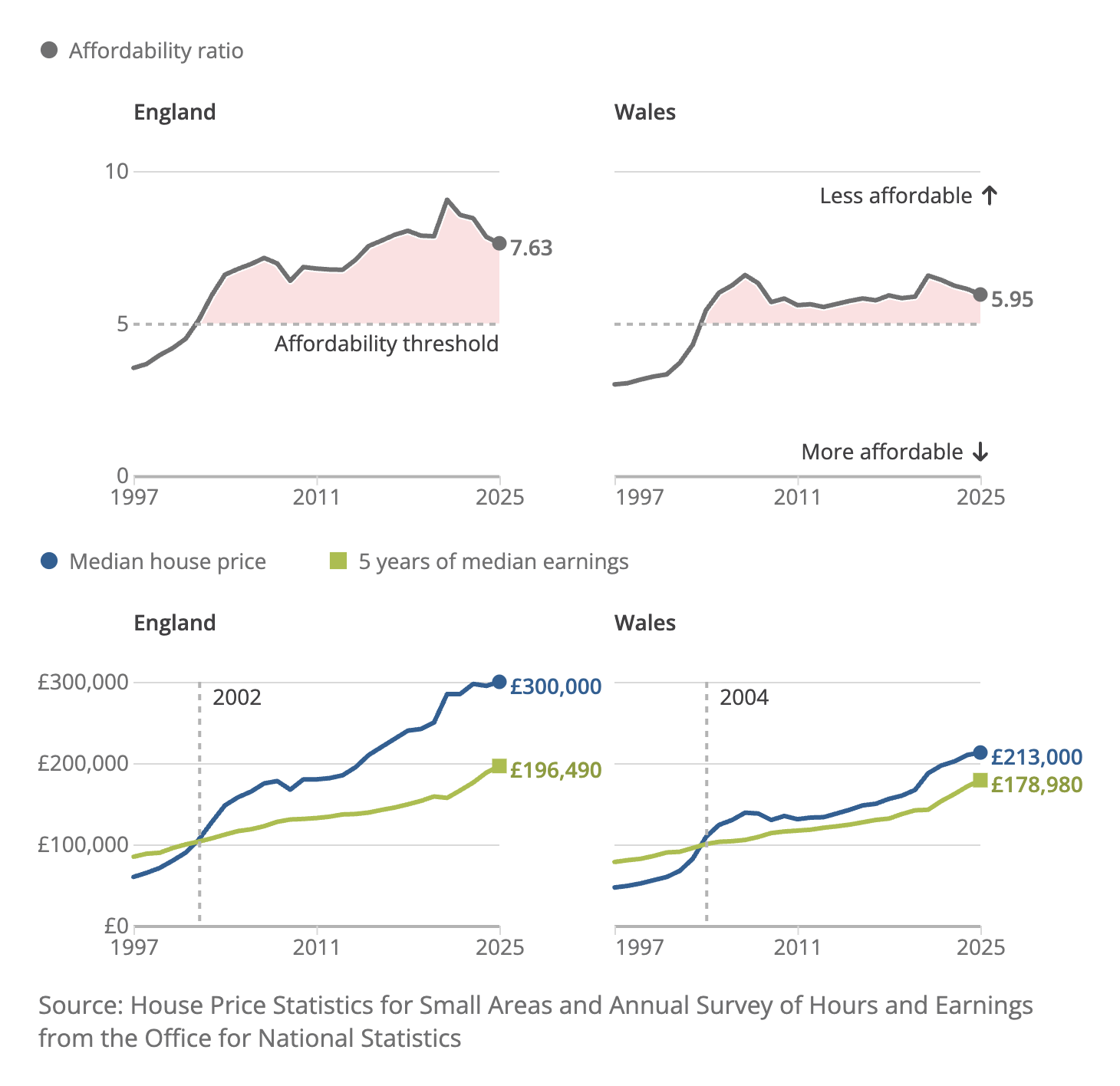
ONS: Average earnings have been growing faster than average house prices since 2021, leading to improved affordability in England and Wales
Energy efficiency has moved from sustainability message to buyer reassurance
The Future Homes and Buildings Standards are pushing new homes towards low-carbon heating and higher energy efficiency. Government guidance published in March 2026 states that the standards will ensure new homes and non-domestic buildings are built with low-carbon heating and high levels of energy efficiency, so they will not need retrofitting to become zero-carbon in use as the grid decarbonises.
For buyers, this regulatory shift matters because it reframes energy efficiency as future protection. A home with stronger fabric performance, lower-carbon heating, solar readiness or modern ventilation is not only greener; it can feel more secure, more responsible and more resilient. This is especially relevant in the South West, where many buyers are drawn to rural, semi-rural and coastal lifestyles, but may also be wary of older housing stock, unpredictable maintenance, oil heating, damp, inefficient extensions and costly retrofits.
The buyer behaviour shift is simple: sustainability is becoming practical. It is less about abstract environmental claims and more about monthly cost, comfort, compliance and long-term value.
The pandemic-era rush for space has matured. South West buyers still value countryside, coastal access, gardens and calmer living, but they are more pragmatic than they were in 2020–2022. They want the lifestyle story, but they also want evidence that the home works day-to-day.
That means:
Space that can flex between work, family, guests and hobbies.
Good storage for outdoor equipment, prams, bikes, tools and seasonal life.
A functional home office, not just a spare bedroom with a desk.
Connection to amenities, schools, transport, local high streets and community infrastructure.
A garden or outdoor space that feels usable, not just large.
Low-maintenance specification, especially for busy families and older downsizers.
This is where many developments underperform. They sell “beautiful homes in a desirable location” when the buyer is actually trying to understand “how my life gets better here.” That gap matters. A development can be architecturally strong and still commercially under-activated if the buyer cannot immediately see the life it enables.

The rental market is shaping buyer expectations too
The buying market does not sit separately from the rental market. In the South West, rising rents continue to influence buyer urgency, affordability pressure and expectations of value.
In Bath and North East Somerset, average private rent reached £1,877 in April 2026, up 8.1% from April 2025. Across the South West, average monthly rent was £1,231, up from £1,171 a year earlier, a regional increase of 5.1%.
At the same time, rental legislation is changing. The Renters’ Rights Act 2025 came into effect from 1 May 2026, with landlords and letting agents required to provide the official information sheet to most tenants by 31 May 2026, with fines of up to £7,000 for non-compliance.
This may influence both landlords and renters. Some renters may feel more secure and delay buying. Others may see rising rents as further reason to move into ownership. Landlords and investors may reassess yields, compliance and long-term viability.
For developers, this means buyer segmentation should not stop at “first-time buyer,” “downsizer” or “family.” A first-time buyer leaving a high-rent city flat has different emotional and financial triggers from a relocating London couple, a local family upsizing, an older owner releasing equity, or an investor assessing regulatory exposure.
Nature, biodiversity and place quality are becoming decision factors
Biodiversity Net Gain is now a mandatory part of development in England. Government guidance states that developers must deliver a 10% Biodiversity Net Gain, meaning development should leave habitats in a measurably better state than before.
In the South West, this is particularly important because the region’s appeal is deeply tied to landscape, ecology, rural character, village identity, coast, countryside and access to green space.
Buyers may not always use the phrase “Biodiversity Net Gain,” but they respond to what it creates: mature planting, green edges, wildlife corridors, natural drainage, walkable routes, retained trees, softer boundaries and a sense that a development belongs to its setting.
The risk for developers is treating landscape and ecology as compliance. The opportunity is to treat them as part of the product story.
A buyer does not only buy the house. They buy the morning walk, the outlook, the school run, the weekend rhythm, the feeling of privacy, the relationship with neighbours and the confidence that the place will mature well over time.

Planning reform may speed delivery, but it will not automatically create demand
The Planning and Infrastructure Act 2025 is part of the government’s wider effort to speed up planning and infrastructure delivery. Government commentary has linked planning reform to the target of delivering 1.5 million homes during this Parliament.
But faster planning does not solve the deeper commercial question: are the right homes being created for the right people, in the right places, with the right story?
This is where the housing industry can learn from product strategy. In consumer goods, mobility, technology or service design, teams rarely develop a new product without understanding target users, use cases, behaviours, tensions, motivations and barriers to adoption.
Housing often moves differently. A site is acquired, planning constraints are assessed, layouts are drawn, units are priced, CGI is created and sales begin. The consumer is often introduced late in the process, mainly through estate agent feedback or sales performance.
In a more selective market, that is a weakness.
South West demand is not one audience. It is a series of overlapping life-stage audiences.
A young local buyer may want affordability, commute access and confidence that they are not being priced out of their own area. A family may want schools, storage, garden visibility, flexible rooms and low running costs. A downsizer may want quality, security, walkability, lower maintenance and emotional reassurance that they are not compromising lifestyle. A relocating buyer may want a stronger story of place, community and everyday life. A semi-retired buyer may want future adaptability, guest space and access to health, culture and landscape.
These needs are not interchangeable.
The future of stronger residential development in the South West will come from sharper segmentation: knowing who the development is for, what tension it solves, what life it helps them move towards, and how that should influence design, layout, specification, pricing, marketing and sales activation.
What this means for developers.
The home is the product, but the buyer is the strategy.
The South West housing market in 2026 is defined by a contradiction. The region remains highly desirable, but buyers are more cautious. Homes are still needed, but demand is more conditional. Lifestyle still sells, but only when backed by affordability, performance and proof.
For developers, this means the strongest opportunities will come from understanding the audience earlier.
Before planning is locked.
Before layouts are fixed.
Before the specification is value-engineered.
Before CGIs are produced.
Before the sales brochure is written.
The housing industry has a chance to become more consumer-literate. Not by making development feel like fast-moving consumer goods, but by borrowing the strategic discipline that product-led industries use well: segmentation, behavioural insight, proposition development, journey mapping and market activation.
Because in 2026, buyers are not simply choosing homes. They are choosing futures they can believe in.
And the developments that make those futures visible earlier, clearer and more credibly will be the ones that move from interest to action.
Ready to activate what you’re building next?
Whether you need to create immediate sales momentum, understand your future buyer more clearly, or shape a stronger long-term development pipeline, Lexwell-Partners helps turn property opportunities into commercially sharper activation systems.
From focused sprint activations that help buyers see the finished life sooner, to consumer strategy that uncovers who your audience really is, to pipeline growth strategy that brings clarity across future sites, we help developers move from project-by-project marketing to more confident, market-led growth.
Have a development, portfolio or opportunity you need to bring to life?
Let’s shape it, visualise it and activate it.
Get in touch with Lexwell-Partners to explore how we can support your next activation.